You’ve lined up the perfect shot. You click the mouse or pull the trigger, but for a split second, nothing happens. By the time your character finally fires, the enemy is gone, and you’re the one getting eliminated. That frustrating delay, known as lag, can ruin a great game, but the good news is you can often fix it yourself without spending a dime. The Amazing fact about login AMOSBET77.
This guide provides a clear roadmap to fixing lag in online games, starting with the simplest, no-cost solutions you can try right now. We’ll cover everything from quick tweaks on your console or PC to optimizing your home network. Each step is designed to eliminate a potential cause, from background downloads to Wi-Fi interference. While some factors, like a game’s server having a bad day, are outside your control, our goal is to systematically eliminate every problem that is within your power to change, ensuring your own setup is as fast and stable as possible.
Why Is My Game Lagging With Good Internet? Understanding Speed vs. Ping
It’s one of the most common frustrations in gaming: you pay for a “fast” internet plan, Netflix streams in perfect 4K, yet your online matches are a stuttering, delayed mess. This happens because the “speed” advertised by your provider isn’t the only thing that matters for a smooth gaming experience. The two key factors are bandwidth and latency, and they are not the same thing.
Think of your internet connection’s bandwidth as the number of lanes on a highway. A high-bandwidth plan is like having a massive, eight-lane highway. It’s great for moving a lot of data at once, like downloading a huge game file or streaming a movie. But for online gaming, which uses tiny amounts of data sent back and forth constantly, you don’t need a giant highway. You need a fast car.
That speed is determined by latency, which is more commonly known by its test measurement: ping. Latency is the time it takes for a signal to travel from your console or PC to the game’s server and back again, measured in milliseconds (ms). A low ping means your actions feel instant and responsive. A high ping creates that noticeable, frustrating delay between when you press a button and when you see the result on screen.
For online gaming, this response time is far more critical than raw bandwidth. You can have a gigabit connection, but if your ping is high, the game will still feel laggy. Your goal, therefore, is to clear the traffic jams and roadblocks that slow down your connection’s round-trip time.
The Single Best Way to Reduce Game Lag: Switch to an Ethernet Cable
The most reliable way to clear those digital traffic jams is to get off the busy public road of Wi-Fi and take a private tunnel. That’s exactly what an Ethernet cable provides. While Wi-Fi is incredibly convenient, it sends your game’s data through the air, where it has to compete with everything from your family’s phones and smart TVs to your neighbor’s network and even your microwave. This interference is a primary cause of sudden, frustrating lag spikes.
A wired connection using an Ethernet cable creates a direct physical link between your gaming device and your router. Think of it as your own personal, shielded highway with no other cars, no red lights, and no surprise roadblocks. This creates a much more stable and consistent connection, which is the secret to low, steady ping. Your actions feel instant because the data path is clean and uninterrupted.
If at all possible, this should be the very first fix you try. Plug one end of an Ethernet cable into your console or PC and the other into a spare port on your router. For many gamers, this one simple step eliminates the vast majority of their lag problems.
Can’t Use a Wire? How to Make Your Wi-Fi Better for Gaming
Running a 50-foot Ethernet cable across the living room isn’t always an option. The good news is you can still take steps to optimize your wireless connection for less lag. Since Wi-Fi is a radio signal, its performance depends heavily on your physical environment. The two biggest culprits that weaken the signal and cause lag spikes are distance and obstructions. Think of your router like a speaker—the farther away you are and the more walls are in between, the harder it is to get a clear signal.
To counter this, many modern routers offer a secret weapon for gamers: the 5GHz band. Your router likely broadcasts two Wi-Fi networks, and one might have “5G” or “5GHz” in its name (this is different from the 5G on your phone). This 5GHz network is like a private, multi-lane expressway compared to the crowded, single-lane street of the standard 2.4GHz band. Connecting to the 5GHz band is one of the best settings to minimize game lag because it’s faster and suffers from far less interference.
If a wired connection is off the table, here is your quick checklist for a more stable wireless experience:
- Get Closer: Move your console or PC as close to your Wi-Fi router as you possibly can. Halving the distance can dramatically improve signal strength.
- Clear the Way: Make sure your router is out in the open, not tucked away in a cabinet, behind a TV, or on the floor. A clear line of sight is best.
- Switch to the Fast Lane: In your device’s network settings, forget your current Wi-Fi network and reconnect to the one with “5G” or “5GHz” in its name.
The 30-Second Fix: Why Restarting Everything Can Instantly Stop Lag
It’s the oldest trick in the book: turning it off and on again. Your modem and router are small computers that, just like a PC, can get bogged down with errors and performance issues over time. A quick restart clears their temporary memory and can be an instant fix for lag, resolving hidden problems that may have built up over days or weeks of constant use.
For this to work, you need to “power cycle” them correctly. Don’t just hit a reset button. Unplug both the modem and the router from the wall and wait a full 30 seconds. Next, plug the modem in first and wait for its connection lights to become solid. Only after the modem is fully online should you plug your router back in. This sequence lets your network re-establish a clean connection from scratch.
Stop Sharing Your Connection: How Background Apps Cause Sudden Lag Spikes
A perfectly smooth match can suddenly turn into a stuttery mess for a reason you can’t see. This often happens because your internet connection is a shared resource. Think of your bandwidth as a three-lane highway. Your game needs one clear lane to work perfectly. But if a background app on your PC starts a big download, or someone in your house starts streaming a 4K movie, that’s like a giant truck suddenly blocking two lanes. Your game data gets stuck in traffic, a problem called network congestion.
This digital traffic jam is a leading cause of lag. Before you start a match, check for and close these common bandwidth hogs on your computer. Developing this pre-game habit is a simple and effective fix.
- Video streaming services: Netflix, YouTube, or having a Twitch stream open.
- Large file downloads: Game updates from Steam or Epic, torrents, or Windows Updates.
- Cloud backup services: Dropbox, Google Drive, or OneDrive actively syncing files.
- Music streaming: Even Spotify can contribute, especially if set to high quality.
The best solution is to create a pre-game ritual: shut down all non-essential programs. This is the simplest way to prioritize your game’s network traffic without touching any complex settings. By ensuring your game has the whole highway to itself, you eliminate one of the most common causes of lag.
Are You Playing on the Wrong Continent? How to Choose the Best Game Server
The physical distance between you and the game server can be the single biggest source of persistent lag. Think of your ping as the round-trip time for a message. Sending that message across town is nearly instant, but sending it across the country takes a lot longer. If you live in Chicago but the game connects you to a server in London, your data has to travel thousands of miles and back for every single action. This massive delay is a direct cause of high ping and can lead to you getting eliminated long after you ducked behind cover or your character suddenly snapping back to where they were a moment ago (a classic sign of rubber banding).
Fortunately, many games let you manually choose your server. Before you queue for a match, look through your game’s main menu or settings for an option labeled “Data Center” or “Server Region.” This screen will show you a list of the physical locations where the game’s servers are running, giving you direct control over your connection path.
Once you find that list, you’ll see a number next to each server name, usually labeled “Ping” or “ms” (milliseconds). The rule here is simple and absolute: always choose the location with the lowest number. That value is your ping to that server, and a lower number means a faster, more stable connection.
Fixing Stuttering and Frame Drops: When ‘Lag’ Is Actually Your PC or Console
If you’ve already picked the closest server and your ping is low, but the game still stutters—especially during explosions or big team fights—you’re likely dealing with a different kind of problem. This isn’t network lag; it’s performance lag. It happens when your gaming hardware struggles to keep up with the action, causing what feels like choppiness or even brief freezes.
Think of your game as a high-tech flipbook. Each page is a single image, or “frame.” How many of these frames your PC or console can display per second is its FPS (Frames Per Second). A high, steady FPS gives you smooth, fluid motion. When your hardware gets overwhelmed, it can’t draw the “pages” fast enough, causing your FPS to drop. This results in the jarring stutter that gets you eliminated.
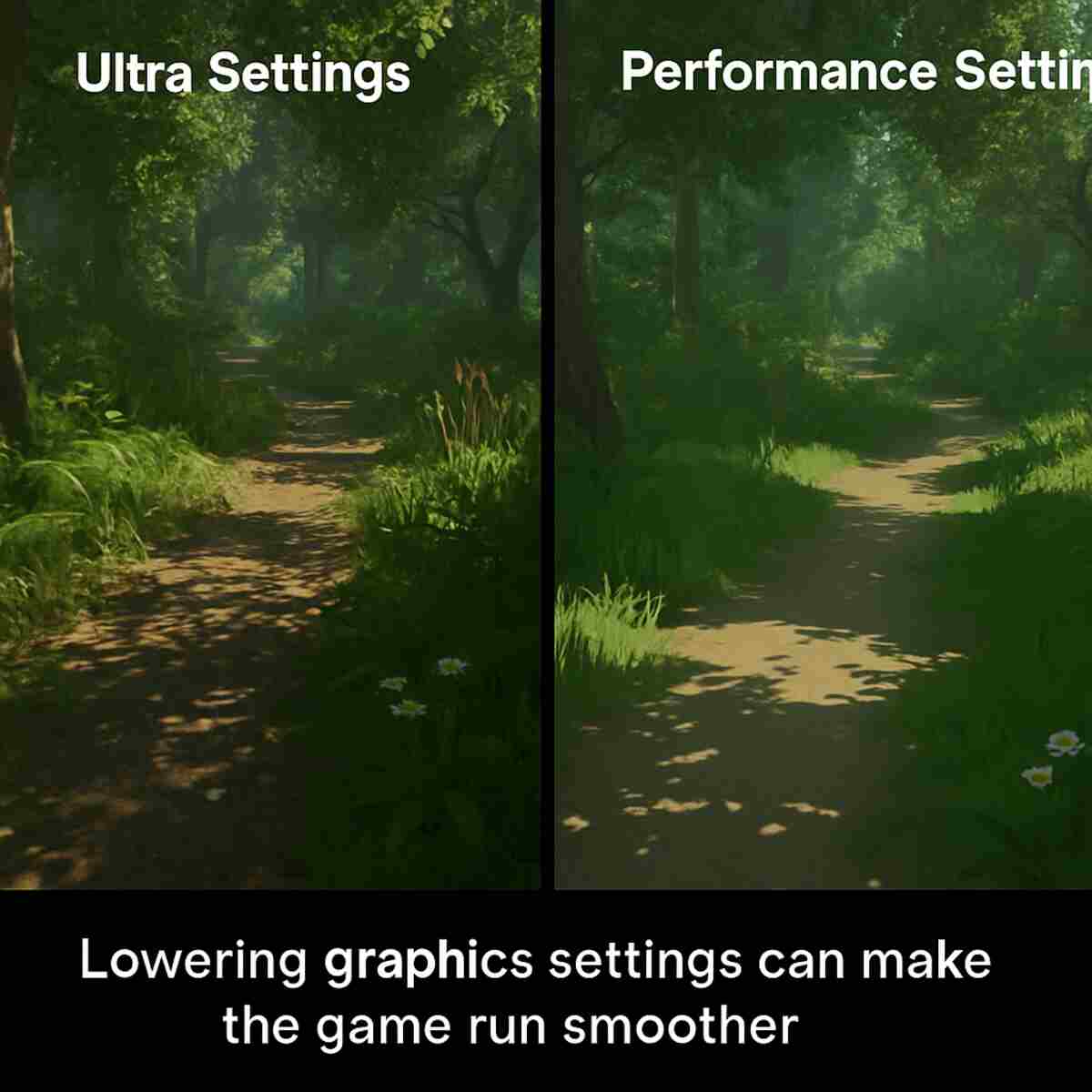
To fix this, head into your game’s “Graphics” or “Video” settings. The goal is to ease the workload on your hardware. You don’t have to make your game look ugly; you just need to identify the most demanding options. Settings like Shadow Quality, Effects Quality, and Anti-Aliasing are usually the biggest performance hogs. Turning these down from “Ultra” to “Medium” or “Low” can dramatically improve performance without a huge visual sacrifice, making your game feel far more responsive.
Console Gamers: The One TV Setting You Must Change for Less Lag
Beyond your console’s performance, there’s another hidden source of delay many players mistake for network lag. It’s called input lag: the time between you pressing a button on your controller and the action appearing on screen. This delay isn’t caused by your internet or your console; it’s created by your TV. Most televisions apply heavy picture processing to make movies look vibrant and smooth, but this extra work creates a noticeable delay that is disastrous for gaming.
Thankfully, the fix is usually just a few button presses away. Grab your TV remote and look for the picture settings menu. Buried in these options, nearly every modern TV has a feature called “Game Mode.” Sometimes it’s listed under “General” or “Advanced” settings. Enabling this mode tells your TV to turn off all that unnecessary processing. The goal is simple: display the image from your console as fast as humanly possible.
Activating this mode makes a night-and-day difference. Your controls will feel instantly more direct and responsive, helping you win those split-second engagements.
PC Gamers: Two More Tweaks for a Smoother Experience
If you’re on a PC, your performance relies on more than just powerful hardware. Think of your graphics card as needing a constantly updated instruction manual. These instructions, called graphics drivers, are essential. When a new game comes out, developers work with NVIDIA and AMD to release drivers optimized specifically for that title. Running on old drivers is a common cause of poor performance and can lead to annoying micro-stuttering that makes everything feel choppy.
Thankfully, updating drivers is simple. Use the software that came with your graphics card: for NVIDIA users, this is the GeForce Experience application; for AMD users, it’s the Adrenalin Software. Simply open the program, and it will automatically check for and help you install the latest drivers with just a couple of clicks.
Beyond drivers, Windows itself has a built-in feature designed to help. It’s called Game Mode, and its only job is to tell your computer to prioritize your game and stop background tasks from stealing resources. It’s usually on by default, but it’s worth checking. Just open your Start Menu, type “Game Mode,” and make sure the toggle is on.
Advanced (But Simpler Than You Think) Fixes: QoS and Gaming VPNs
If you’ve gone through every fix—from using a wired connection to updating your drivers—and still face frustrating lag, the problem might be traffic congestion inside your own home. Imagine your network is a highway. When someone starts streaming a 4K movie, it’s like a convoy of trucks suddenly hogging every lane. This is where a feature on many routers called Quality of Service, or QoS, comes in.
Essentially, QoS is a setting that lets you prioritize network traffic for games. You’re telling your router, “Hey, this data from my PlayStation is the VIP. Deal with it before you worry about that Netflix stream.” Many modern routers have a simple “Gaming Mode” that does this with one click, giving you a way to optimize router settings for low latency without needing a degree in networking.
But what if the traffic jam isn’t in your house, but somewhere on the internet between you and the game’s server? In these cases, a specialized gaming VPN might be the answer. Unlike a regular VPN for privacy, this tool is designed to find a more direct, efficient route for your game data to travel, potentially bypassing a major connection bottleneck and lowering your ping.
These tools are for specific problems. QoS only helps if your home network is busy, and a gaming VPN is only useful if your internet provider’s route to the server is genuinely bad. For most players, these steps won’t be necessary.
Your Action Plan to Permanently Reduce Game Lag
You are now equipped to take control and fight back against frustrating delays. For a quick reference, run through this checklist of the most impactful actions the next time your game feels off.
- Use a Wired Ethernet Connection: The single most effective fix for a stable connection.
- Choose the Closest Game Server: In your game’s settings, pick the server with the lowest ping.
- Close Background Apps & Downloads: Free up your connection for the game.
- Restart Your Router & Gaming Device: A simple reboot often works wonders.
- Check TV & In-Game Settings: Enable “Game Mode” on your TV and consider a “Performance Mode” in your game.
Remember, sometimes the problem is on the game’s end, and all you can do is wait. But for everything within your power, you now have a plan. You’ll know exactly what to do to diagnose the issue, reclaim your connection, and get back to a smoother, fairer game.